+34 967 142 011


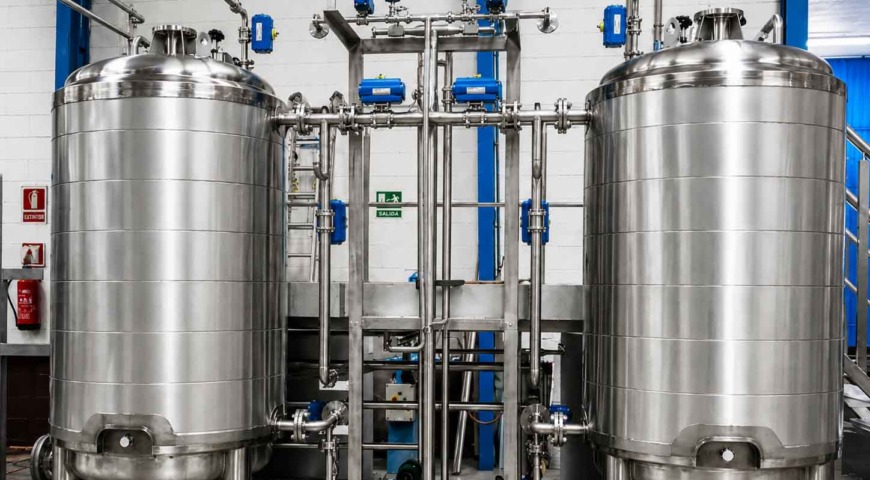
An industrial process is an organised set of physical, chemical, thermal or biological operations that transforms raw materials into intermediate or finished products. It includes stages such as storage, dosing, mixing, reaction, separation and quality control, and each one depends on equipment designed for the specific conditions of the product and the process.
This article explains what an industrial process is, what types exist, how it is organised into stages and, above all, what equipment corresponds to each operation and what variables determine its design.
What are industrial processes?
An industrial process is not the same as a production process or a unit operation. The industrial process is the complete set of activities that transforms a raw material. The production process is a broader concept, a set of activities that also includes planning, purchasing, control and distribution. A unit operation is an individual technical stage within the process: storing, mixing, heating, reacting, separating or conveying are distinct unit operations, each with a specific function, even though they form part of the same process. Many industrial companies organise their production by combining several of these operations.
Types of industrial processes
Types of industrial processes and their production cycles are classified according to different axes, which should not be mixed with each other. Each production model requires different equipment sizing.
| Classification axis | Categories |
| Nature of the transformation | Physical, chemical, thermal, biological, mechanical, separation |
| Production flow | Continuous, batch, semi-continuous |
| Volume and configuration | Made-to-order, batch, series, mass |
| Level of automation | Manual, semi-automated, automated |
A continuous process requires constant feed, stable flow rates and permanently connected equipment. A batch process, on the other hand, needs equipment capable of loading and unloading defined quantities, with cleaning between batches and individual traceability. A semi-continuous process combines continuous feed with periodic discharge, supported by buffer storage that synchronises both rates.
Stages of an industrial process
An industrial process is a set of stages that can follow different sequences. The one that connects best with equipment design is: receipt of raw materials, initial storage, dosing, preparation or conditioning, transformation, separation or purification, finishing, final storage and dispatch. There is no single sequence valid for all industries: the order and the weight of each stage change according to the product and the sector.
Unit operations and equipment
Each unit operation requires specific equipment and depends on particular variables that determine its design.
| Industrial operation | Typical equipment | Main variables |
| Liquid storage | Vessel or tank | Level, temperature, pressure |
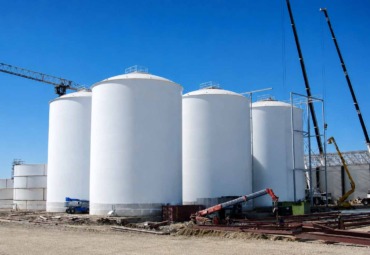
| Solid storage | Silo or hopper | Weight, moisture, level |
| Mixing and homogenisation | Reactor or agitated tank | Speed, time, viscosity |
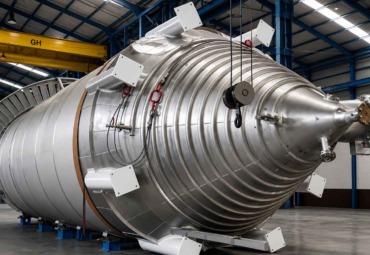
| Reaction | Industrial reactor | Temperature, pressure, time, pH |
| Fermentation | Fermenter | Temperature, oxygen, pressure |
| Heating or cooling | Heat exchanger or jacketed equipment | Temperature, flow rate |
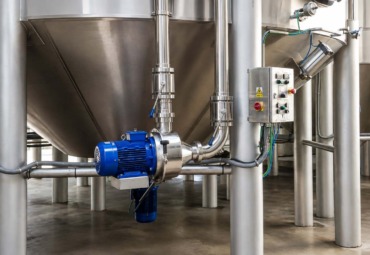
| Fluid conveyance | Pipework, valves and pumps | Flow rate, pressure, head loss |
| Separation | Filter, settling tank or centrifuge | Particle size, density |
| Dosing | Hopper, vessel or weighing system | Weight, volume, flow rate |
An industrial process does not depend solely on the order of its operations, but on each piece of equipment being suited to the product, the capacity, the pressure, the temperature, the viscosity, the corrosiveness and the applicable regulations.
At Eurocalder, we design and manufacture vessels and tanks, industrial silos, reactors and heat exchangers adapted to these variables, as well as pipework networks for conveyance between operations.
Variables to control in the design
Not all variables come into play in every process, but several directly determine the equipment:
| Variable | Design implication |
| Pressure | Thickness, geometry and manufacturing code |
| Temperature | Material, insulation and thermal system |
| Corrosiveness | Material selection |
| Viscosity | Agitation and pumping |
| Capacity | Volume and dimensions |
| Flow rate | Diameters, pumps and pipework |
| Weight | Structure, supports and weighing system |
The weight is controlled using load cells. The documentary traceability is required by a certified quality management system. The accuracy of a process depends both on the physical equipment and on its integration with industrial control.
Automation and control of industrial processes
These production systems rely on basic instrumentation that includes level, temperature, pressure and flow sensors, as well as weighing systems. The actuating elements – valves, pumps, agitators, heating or cooling systems – execute the commands generated by a PLC or a SCADA system, which also logs alarms, manufacturing recipes and traceability. Implementing automated processes does not replace good mechanical design: a well-programmed control system does not fix incorrectly sized equipment.
Examples of industrial processes by sector
These process examples show how technical requirements change by sector:
- Food and beverage: hygiene, cleaning, thermal control and fermentation in equipment for food and beverage.
- Chemicals and process: material compatibility, corrosion and containment of liquids, gases or plastics in equipment for the chemical industry.
- Pharmaceutical and cosmetics: traceability, dosing and homogeneity in equipment for pharmaceutical and cosmetics.
- Paper and pulp: large volumes and abrasive products in equipment for paper and pulp.
- Water treatment: storage of reagents and neutralisation in equipment for water treatment.
Common challenges in industrial processes
Bottlenecks, insufficient capacity, poor mixing, head loss, high energy consumption or difficulty cleaning are common challenges. Most do not stem from a single faulty machine, but from the interaction between several operations that are poorly matched to each other. An oversized vessel creates waiting times. A pipe with excessive head loss holds back product. A poorly calibrated control system causes traceability errors. The three failures look like the same symptom on a production line, but they have different causes.
How to improve the efficiency of an industrial process
Efficiency does not depend solely on automation: correctly sized equipment reduces product losses, waiting times and energy consumption. Making the most of usable volume, heat recovery, thermal insulation and reducing unnecessary transfers are design decisions with a direct impact on process performance.
Good resource optimisation combines preventive maintenance, leak control and appropriate sizing, which translates into a sustained reduction in costs over time, not just a one-off saving. The most efficient production processes and manufacturing processes tend to share these same design decisions.
Safety, quality and maintenance
A reliable industrial process requires continuous quality control, traceability and verification of the product against the quality standards defined for each sector. Safety depends on managing pressure, temperature, overfilling and access for maintenance. Maintenance requires the equipment to allow internal inspection, cleaning and complete emptying without compromising production. Training staff in these procedures reduces the risk of errors.
The importance of equipment design and manufacturing in industrial processes
Designing the right equipment for each operation, rather than simply choosing a catalogue product, is what prevents the above challenges from the outset. Every industrial project requires manufacturing to be adapted to its specific conditions.
At Eurocalder, we develop engineering, manufacturing and assembly projects adapted to the conditions of each process, with pressure equipment and ancillary systems designed together with the rest of the plant’s operations.
Do you need to design or adapt equipment for your industrial process? Request a technical assessment.
Frequently asked questions
What is an industrial process?
It is an organised set of physical, chemical, thermal or biological operations that transforms a raw material into an intermediate or finished product. It includes stages such as storage, dosing, transformation, separation and quality control, and depends on equipment designed for the specific conditions of each operation.
What is the difference between a continuous process and a batch process?
A continuous process maintains a constant feed and permanently connected equipment, with stable flow rates and automatic control. A batch process loads and unloads defined quantities, requires cleaning between batches and offers more flexibility to change formulation, at the cost of longer preparation time between cycles.
What is a unit operation?
It is an individual technical stage within an industrial process, such as storing, mixing, heating, reacting, separating or conveying. Each unit operation corresponds to specific equipment – vessel, reactor, heat exchanger or pipework – and depends on specific variables such as temperature, pressure or flow rate.
What equipment is involved in an industrial process?
It depends on the operation: storage uses vessels, tanks or silos; reaction and mixing require reactors; heating or cooling is handled with heat exchangers; and fluid conveyance requires pipework, valves and pumps. The right equipment depends on the product, the capacity, the pressure and the working temperature.
How does the equipment material influence the process?
The material determines corrosion resistance, compatibility with the product stored or processed, and ease of cleaning in food or pharmaceutical applications. An incorrectly selected material can cause product contamination, premature equipment failure or non-compliance with the regulations applicable to the sector.
Summary
- An industrial process, a production process and a unit operation are distinct concepts that should not be confused.
- Processes are classified according to four independent axes: transformation, production flow, volume and automation.
- Each unit operation corresponds to specific equipment, determined by variables such as pressure, temperature, viscosity or weight.
- Automation does not fix incorrectly sized equipment: mechanical design is the basis of process performance.
- Many plant problems stem from the interaction between poorly matched equipment, not from a single machine.