+34 967 142 011


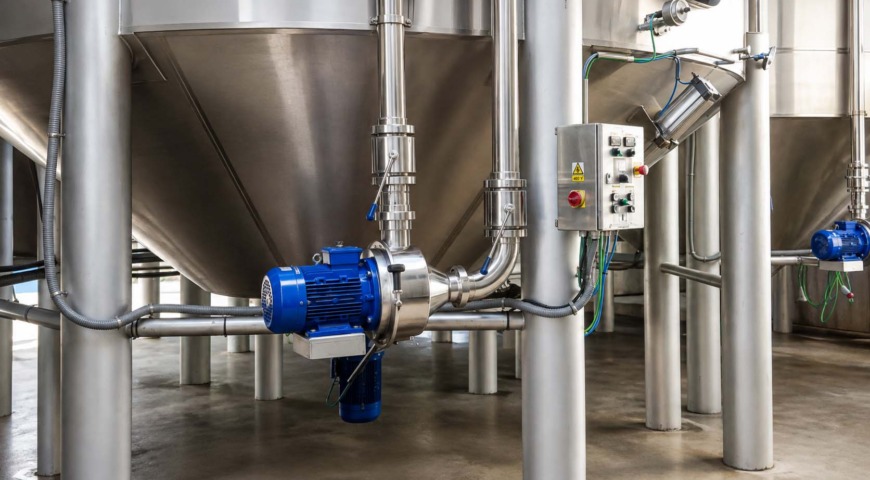
An industrial agitator induces movement in a fluid inside a vessel or reactor to mix, homogenise, disperse or keep solids in suspension in liquids. Choosing the right agitator is not enough on its own: the result depends as much on the agitator itself as on the vessel it is installed in, something many product catalogues do not explain.
This article explains what types of industrial agitators for tanks exist, what parameters determine their selection and, above all, why the design of the agitator and that of the vessel must be resolved together.
What is an industrial agitator?
An industrial agitator is a device that combines a drive unit (motor and gearbox), a shaft and one or more impellers that generate a specific flow pattern inside a vessel or reactor. The quality of a mixing system does not depend on the agitator alone: the best-performing designs resolve the needs of the process and those of the vessel structure together.
At Eurocalder, we design and manufacture vessels and reactors with agitation systems integrated from the engineering stage, rather than treating agitator manufacturing as a part added to an already closed vessel.
Agitation, mixing, homogenisation and dispersion: the differences
| Concept | What it means |
| Agitation | Movement induced in a fluid inside a vessel |
| Mixing | Combination of two or more components to achieve a specific distribution |
| Homogenisation | Obtaining uniform properties throughout the product |
| Dispersion | Distribution of a solid, liquid or gaseous phase within another |
| Suspension | Keeping solid particles distributed in a liquid |
Not all agitators produce the same degree of mixing or are suited to the same operation.
Applications of industrial agitation
Agitation plays a role in homogenisation, dissolving solids, keeping solids in suspension, dispersing and emulsifying phases, neutralisation and chemical reaction, fermentation, heat transfer and preventing thermal stratification. Each application requires a different type of impeller and speed.
Types of agitators by installation
The top-entry vertical agitator, installed on the vessel cover, is the most common choice for general mixing, homogenisation and reactors. The side-entry agitator, mounted on the shell, is used in large vessels to maintain uniformity without occupying the top. The bottom-entry agitator provides good circulation from the base with less dead volume, useful in hygienic applications. The submersible agitator works within the fluid and is common in water and sludge treatment. The portable agitator is used in drums or IBCs, and the magnetic agitator avoids direct mechanical penetrations in hygienic processes or closed equipment.
Flow types and impellers
Depending on the flow direction they generate, impellers are classified as axial (product flows parallel to the shaft, suited to homogenisation and suspension), radial (product flows towards the wall, for dispersion and greater turbulence) and tangential (the fluid rotates around the shaft, with a risk of vortex if the tank has no baffles).
The impeller rotation speed affects the efficiency of mixing processes as much as the impeller design itself. The most common types include the marine propeller and the hydrofoil for low-viscosity liquids, the pitched-blade turbine for general mixing, the radial or disc turbine for dispersion, and the anchor or helical ribbon for high-viscosity products.
Components of an industrial agitator
An agitator combines a drive unit (electric or pneumatic motor, geared motor, frequency inverter), a gearbox that increases the available torque, a coupling, a shaft that transmits movement to the impeller, bearings and supports, and a leak-tightness system – seal, stuffing box or single or double mechanical seal – that prevents leaks at the point where the shaft passes through the vessel. The flange and the anchoring transmit the agitator’s loads to the vessel structure.
How an agitator is selected: key parameters
| Block | Relevant data |
| Product | Density, viscosity, Newtonian or non-Newtonian behaviour, solids in liquids, particle size, shear sensitivity |
| Process | Required operation, mixing time, continuous or batch, need for CIP |
| Vessel | Capacity, diameter, height, bottom geometry, baffles |
| Environment | ATEX zone, ambient temperature, IP protection, hygienic requirements |
There are no simplified rules along the lines of “so many kW per cubic metre”: sizing requires real data on the fluid, the geometry and the desired outcome.
Joint design of the agitator and the vessel
This is the block that decides whether a well-selected agitator actually performs well in practice. The ratio between the vessel’s height and diameter affects circulation, the number of impellers required and dead zones. Baffles reduce the vortex and improve vertical circulation; without them, the product can rotate as a single body without actually mixing.
The bottom – flat, conical, domed or self-draining – determines drainage, sedimentation and impeller position. Internal elements – coils, probes, supports – can create agitation shadows if they are not coordinated with the agitator design. A correctly selected agitator can perform poorly if the vessel’s geometry, supports or connections have not been designed together with it.
Power, torque and speed
Power is the mechanical energy supplied to the system; torque is the drive unit’s capacity to overcome the product’s resistance. Rotation speed affects the flow pattern, shear and the risk of vortex, and the impeller diameter has a decisive influence on pumping and the power required. Increasing the speed does not always improve mixing: it can increase foaming, shear or consumption without any real benefit.
Pressure, vacuum and leak-tightness
In pressure or vacuum vessels, the leak-tightness system must be chemically compatible with the product, withstand the working pressure and allow for cooling or lubrication where required. A single or double mechanical seal is not interchangeable between applications: the choice depends on the acceptable leak risk and the process conditions.
Hygienic design and CIP cleaning
In food, pharmaceutical and cosmetics applications, the agitator must allow effective cleaning without disassembly: a suitable surface finish, hygienic welds, no dead zones, and gaskets compatible with the detergents used. The shaft and blades can create cleaning shadows if not correctly positioned, in the same way as any internal element in a vessel prepared for CIP.
Safety and ATEX zones
In potentially explosive atmospheres, the motor, earthing, static electricity control and overtemperature protection must be matched to the specific zone, category and group of the installation. An agitator should never be presented as “ATEX” in a generic way: the exact configuration depends on the risk analysis of each plant.
Common problems
| Problem | Possible causes |
| Non-homogeneous product | Unsuitable impeller, position or power |
| Vortex | Absence of baffles or incorrect installation |
| Excessive consumption | Oversized equipment or inefficient impeller |
| Vibrations | Shaft, alignment or structural loads on the vessel |
| Leaks | Unsuitable or deteriorated seal |
Industrial scale-up
A result obtained in the laboratory cannot be transferred to plant scale simply by multiplying dimensions: scale-up must take into account power per volume, tip speed, pumping capacity and mixing time, among other variables, to maintain the same process outcome at a larger scale.
Agitators by sector
Requirements vary widely between industrial sectors. In food and beverage, agitation plays a role in mixing, dissolution and fermentation. In the chemicals and process sector, it plays a role in reaction, neutralisation and dispersion. In pharmaceutical and cosmetics, in emulsions and hygienic homogenisation. In water treatment, in coagulation, flocculation and sludge homogenisation.
Design and manufacture of vessels and reactors with integrated agitation
At Eurocalder we carry out industrial metalwork projects for different processes and sectors, designing mixing and homogenisation reactors, temperature-controlled reactors and fermenters with agitation systems integrated from the engineering stage, as well as vessels and tanks ready to receive an agitator according to the client’s process.
Do you need a vessel or reactor with a custom-built agitation system? Request a technical consultation.
Frequently asked questions
What is an industrial agitator?
It is a piece of equipment that combines a drive unit, a shaft and one or more impellers to induce movement in a fluid inside a vessel or reactor. Its function is to mix, homogenise, disperse phases or keep solids in suspension, depending on the impeller and speed selected.
What is the difference between an agitator and a mixer?
In practice, both terms are used in a similar way to describe the equipment that induces movement in a fluid. The difference usually lies in the context: “agitator” is more common in process vessels and reactors, while “mixer” is often used for equipment specifically for mixing solids or pastes.
Which impeller is used for viscous products?
For high-viscosity products, anchor or helical ribbon impellers are used, which work close to the vessel walls and generate laminar flow. For low or medium viscosities, marine propellers, hydrofoils or pitched-blade turbines are more common.
What are baffles for?
Baffles break up the tangential flow that causes the whole product to rotate as a single body around the shaft, without actually mixing. They improve vertical circulation, reduce the vortex and increase mixing efficiency, especially in vessels without a side-entry agitator.
Does Eurocalder supply both the vessel and the agitation system?
Eurocalder designs and manufactures vessels and reactors with agitation systems integrated from the engineering stage, resolving the vessel’s geometry, baffles, bottom and the structural loads generated by the agitator together, rather than treating it as a part added to an already built vessel.
Summary
- The performance of an agitator depends as much on its selection as on the design of the vessel it is installed in.
- Agitation, mixing, homogenisation, dispersion and suspension are distinct concepts, not interchangeable synonyms.
- The flow type (axial, radial or tangential) and the impeller must be chosen according to the product and the operation required.
- The baffles, the bottom and the vessel’s internal elements affect both mixing efficiency and CIP cleaning.
- An agitator should never be presented as suitable for any process or as “ATEX” in a generic way.