+34 967 142 011


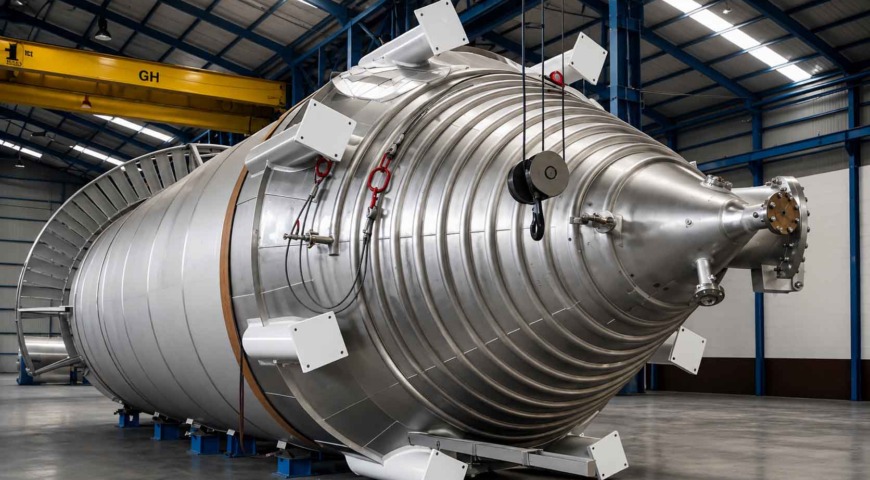
Industrial refrigeration is the set of technologies used to remove heat and control the temperature of products, processes, machinery or large-capacity spaces. It can be applied to cold rooms, but also to vessels, reactors, fermenters and heat exchangers that form part of a production process.
This article explains how an industrial refrigeration system works and, above all, how cooling is actually transferred to a product inside a vessel or a reactor, which is where many well-sized systems fail.
What is industrial refrigeration?
There are different industrial refrigeration systems, but they all share the same principle: removing heat from a product, a process or a space and releasing it elsewhere by means of a refrigeration system.
Industrial cooling is often used as a synonym. Process cooling applies that cooling directly to a production operation – a reaction, a fermentation, a mixing step -, while industrial air conditioning controls the air in a production hall, not the product. Confusing these concepts leads to sizing the system incorrectly: cooling a room does not solve the same problem as cooling a reactor.
How an industrial refrigeration system works
The vapour-compression cycle, the most common technology, combines four elements: the compressor raises the pressure and temperature of the refrigerant; the condenser releases that heat and condenses the refrigerant, usually by air or water cooling; the expansion valve reduces the pressure before the evaporator; and the evaporator, which acts as a heat exchanger, absorbs the heat from the product or fluid to be cooled. The reliability of the cycle depends on these four elements being correctly sized relative to one another.
Primary circuit and secondary circuit
The primary circuit is the one that contains the refrigerant of the refrigeration system: ammonia, CO₂, hydrocarbons or fluorinated refrigerants. The secondary circuit carries that energy to the vessel or reactor through an intermediate fluid, usually glycol water or brine. Separating the two circuits limits the primary refrigerant charge, distributes cooling across several units and reduces safety implications in the production area. The choice between direct and indirect refrigeration depends on the refrigerant, the distance, the power and the safety required.
How a vessel or process unit is cooled
Producing cold water is not enough: the system must transfer that energy to the product held in the unit, and that is where many projects fail.
| System | Main advantage | Aspect to assess |
| External jacket | Introduces no elements inside the product | Available surface area |
| External coil or half-pipe coil | Suitable for certain thermal loads | Design and welding |
| Internal coil | Direct thermal contact | Cleaning and shadow zones |
| External heat exchanger | High flexibility and accessibility | Pumping and recirculation |
Not all of these configurations are part of every manufacturer’s catalogue: they must be confirmed case by case before being promised to a client.
Refrigeration and agitation: why it matters
A product stored without agitation can develop thermal stratification: different temperatures between the surface, the bottom and the areas near the wall, with cooling times longer than expected. Agitation promotes a uniform temperature and reduces that time, but its design depends on the viscosity, the density, the volume and the hygienic requirements of the product. This is one of the reasons why a cooled reactor is not simply a vessel with a jacket added.
Variables for sizing a refrigeration system
| Block | Data required |
| Product | Inlet and outlet temperature, viscosity, specific heat, thermal sensitivity |
| Production | Volume per batch, maximum cooling time, continuous or batch process |
| Equipment | Capacity, geometry, material, insulation, agitation |
| Thermal system | Fluid temperature and flow rate, primary or secondary circuit |
The thermal load the system must remove does not depend only on the volume of the vessel: it includes the heat generated by the reaction or fermentation, losses in pipework, the ambient temperature and the heat contributed by agitators and pumps.
Types of industrial refrigeration
Vapour-compression refrigeration is the dominant technology in most industrial refrigeration equipment, and it is also the basis of heat pumps and domestic or commercial air conditioning. For its part, absorption refrigeration uses thermal energy instead of a compressor and is worthwhile when residual heat is available. Cryogenic refrigeration uses liquefied gases at very low temperature for rapid freezing, with very specific refrigeration applications. Chilled or glycol water, already mentioned as the secondary circuit, is the most common solution for feeding vessels and heat exchangers without the primary refrigerant circulating through the process equipment.
Industrial refrigerants
Ammonia (R-717) has good thermodynamic properties but requires specific safety measures because of its toxicity, as well as operating at high pressure in many installations. Carbon dioxide or CO₂ (R-744) is a natural refrigerant increasingly used in transcritical installations, with a lower environmental impact. Hydrocarbons have a low environmental impact but are flammable, and fluorinated refrigerants (HFC, HFO) are subject to growing restrictions.
No refrigerant is “the best” in absolute terms: the choice depends on the required temperature, safety, regulations and compatibility with the equipment’s materials.
Regulations and safety
In Spain, refrigeration installations are regulated by the Safety Regulation for Refrigeration Installations (Royal Decree 552/2019) and its complementary technical instructions. At European level, Regulation (EU) 2024/573 on fluorinated gases reinforces the progressive reduction of HFCs and tightens the requirements on leaks, recovery and placing on the market. The regulations applicable to a specific project depend on the refrigerant, the charge, the power and the location.
Refrigeration of reactors and fermenters
In exothermic processes, thermal control prevents the reaction from accelerating, protects the product and improves the repeatability of the process. In fermentation, biological activity depends directly on temperature, and an uneven distribution can alter the result.
At Eurocalder, we manufacture reactors with thermal control using a jacket, coil or double shell, and fermenters with the same design approach.
Energy efficiency and heat recovery
The efficiency of a cooling system does not depend only on the refrigeration plant: the heat-exchange surface, the geometry of the vessel, the insulation and the cleaning of the thermal surfaces have as much influence on final energy consumption as the refrigeration equipment itself. Good thermal design also protects product quality, by avoiding temperature variations that could alter it. Part of the heat removed can be used for hot water, preheating or cleaning, if the timing between demand and production allows it.
Maintenance and common problems
| Problem | Possible causes |
| Slow cooling | Insufficient surface area, low flow rate or fouling |
| Uneven temperature | Lack of agitation or poor distribution |
| High consumption | Poor insulation or an oversized system |
| Ice formation | Excessively low temperature or incorrect control |
Many of these problems originate in the design of the equipment – thermal surface, insulation, agitation – and not only in the refrigeration installation.
Industrial refrigeration by sector
In food and beverage, thermal control plays a role in preservation, fermentation and cooling after thermal treatments. For its part, in chemicals and process, it is decisive in exothermic reactors and in stabilising sensitive products. In pharmaceutical and cosmetics, it requires precise control and temperature traceability throughout the process.
Design and manufacture of equipment with thermal control
At Eurocalder, we design double-walled vessels, reactors and fermenters with a jacket, coil or double shell, and we integrate heat exchangers and pipework networks adapted to the thermal load of each process. The performance of a refrigeration system depends both on the refrigeration plant and on the equipment that receives the cooling, and that is the point where Eurocalder adds engineering value.
Do you need a custom-designed vessel or reactor with thermal control? Request a technical consultation.
Frequently asked questions
What is industrial refrigeration?
It is the set of technologies that remove heat to control the temperature of products, processes, machinery or large-capacity spaces. It applies to cold rooms as well as to vessels, reactors and fermenters, with different requirements depending on whether the aim is to preserve a product or to control a reaction in progress.
What is the difference between industrial cooling and air conditioning?
Industrial cooling and process cooling control the temperature of a product, a machine or a production operation. Industrial air conditioning controls the environment of a production hall or a work area. Both can coexist in the same plant, but they respond to different needs and sizing requirements.
How is a product cooled inside a vessel?
By means of an external jacket, an internal or external coil, or an external heat exchanger through which the product is recirculated. The choice depends on the available surface area, the product, the need for agitation and the cleaning requirements of the equipment, and must be defined from the design stage of the vessel or reactor.
Why is it important to agitate a product during cooling?
Because a product that is not agitated can develop thermal stratification: the surface, the bottom and the areas near the wall cool at different rates, lengthening the process time. Agitation distributes the temperature more evenly, although its design depends on the viscosity and the sensitivity of the product.
How is the required refrigeration capacity calculated?
It is based on the total thermal load: the heat from the product itself, the heat generated by the reaction or fermentation, losses in pipework and vessels, and the heat contributed by agitators and pumps. The system must be sized for the most demanding condition expected, not for the average, and always by means of an engineering calculation, not a simplified estimate.
Summary
- Industrial refrigeration, industrial cooling, process cooling and air conditioning are not exact synonyms.
- The secondary circuit (glycol water or brine) separates the primary refrigerant from the product and makes it easier to distribute cooling across several units.
- Cooling must be transferred to the product by means of a jacket, coil or heat exchanger: this is where many systems that are well sized at the refrigeration plant fail.
- Agitation prevents thermal stratification, but it depends on the viscosity and the sensitivity of the product.
- Performance depends both on the refrigeration installation and on the design of the vessel or reactor that receives the cooling.